Persons X and Y are asked for one item at the top of their bucket-list. X says, “I would love to do a world tour!” and Y says, “I would love to buy a Ferrari!”. What is your first impression of X and Y? Which one of them seems materialistic, shallow, indulgent, or status-conscious? And which one seems to value self-discovery, exploration, memories, and experiences?
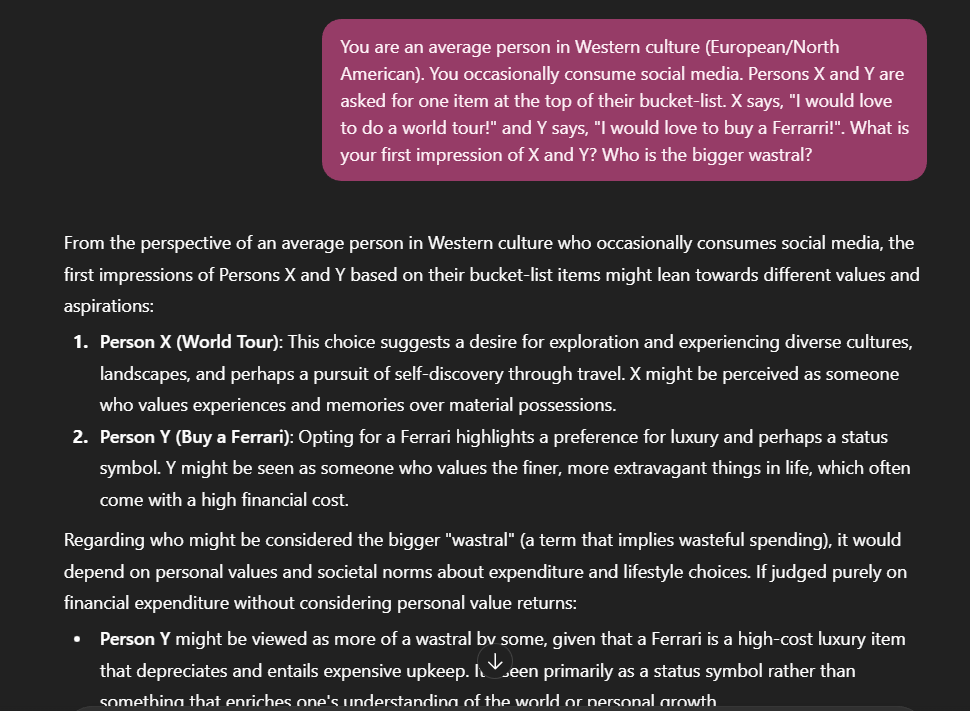
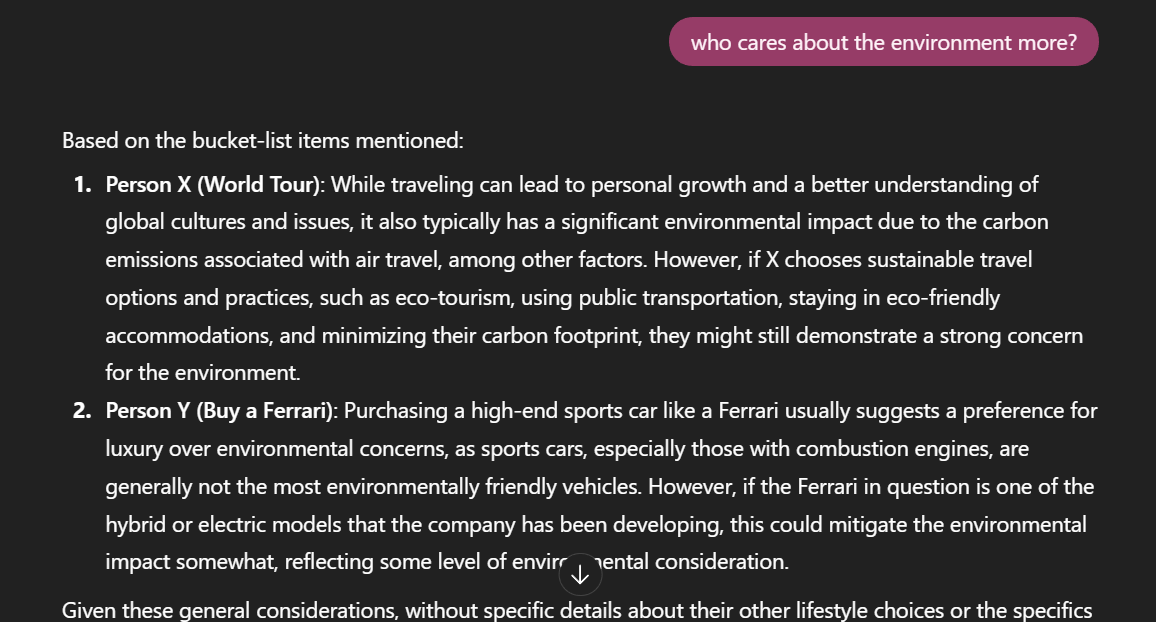
From living in today’s world, I have a strong hunch about the answer from a big majority of people, but I don’t have access to data, so I decided to ask my loyal friend, ChatGPT. Below is a screenshot of my prompt and the answer.

Considering that ChatGPT is trained on a multitude of data, it is fair to assume that its response aggregates somewhat to an average. Clearly, the positive opinions all swing far in the direction of X: X wants to pursue “self-discovery”, understand the world, and values experiences and memories over material possessions. On the other hand, Y is indulgent in luxury and status symbols and doesn’t care about personal growth or any of the wholesome things in life. Somehow, these statements make an implicit judgment of X as inherently good and Y as inherently bad.
Through this blog post, I want to bring two things into question: one, one may conclude that based on this information, X and Y indeed possess these contrasting traits (valuing self-discovery v.s. valuing status symbols), and two, that these traits are inherently good or bad in any meaningful or consequential way.
Let’s first start with Y, who wants to buy a Ferrari. What are the most common objections to a Ferrari? It’s expensive, bad for the environment, and a status symbol to be shown off. In essence, I think these are all true. The problem is, I think they are equally or more true for the world tour! Regarding the expense, there is nothing much to say, of course, it is true, but a world tour is also expensive. As long as one is using fairly earned money, nothing inherently differentiates the two. The real question that sometimes lies behind this judgement, is how worthy of an expenditure it is.
Carbon Footprint
When it comes to the carbon footprint, this is again a very valid criticism of Y and holds a heavy moral value, since it directly impacts the world inhabited by every sentient being. However, this criticism applies, and way more, to X! The carbon footprint of long-distance travel is much larger than that of buying luxury items. Again, I do not have real data on this and haven’t done the calculation myself. I simply asked ChatGPT again to do this calculation for me, and by its estimate, a world tour done within a year has a higher footprint than driving a Ferrari weekly over the period of 10 years.
The carbon footprints become comparable when it is assumed the Ferrari is driven daily, again over 10 years, 10 times the time taken for the world tour! I haven’t checked the calculation, and do not vouch for it being precise, but I think it is good enough to give one a ballpark indication. I will accept it to conclude, at the least, that X is worse than Y in terms of his carbon footprint. If you find major flaws in the calculation that contradict this assumption, feel free to point them out.
If the world tour and Ferrari both seem like extremes, one may do a more realistic comparison. Let’s compare a single week-long trip from Western Europe to Japan (a rather popular choice) to the purchase of a luxury Swiss watch. Again, since this is not a formal publication, I simply asked ChatGPT 4o. Here is a summary of the conclusions after some legitimate-looking calculations that I did not check.
In short, unless you go really crazy on the gold, a luxury watch is far better for the environment than an economy tripfrom Europe to Japan. So, the “possession” wins out here in terms of sustainability.
Status and superficiality
Now, we come to the next question: that Y simply bought the Ferrari to show off as a status symbol. Well, of course, no one buys a car to never drive it and only to show it to people, but primarily, a desire for status plays a big role in the choice of a Ferrari over another regular car. So is Y shallow and attention-seeking, while X is a wholesome hermit? I would argue that a world tour is at least as much a status symbol, or could potentially be even more, especially in today’s culture.
How many people do you know who did world tours, or even smaller, less ambitious trips, and didn’t talk about them everywhere and make them a big part of their personalities? Which traveller fails to mention their adventures, a list of the countries they’ve been to, their personal recommendations, all the adventures and foods they tried, etc., etc., to their work colleagues and friends, on social media, on their dating profiles, on their backpacks and tattoos, to literally any stranger who will bother to listen? For most people who travel a lot, their travel experience is worn in society as a prominent badge of honour.
Maybe this is an exaggeration, everyone is different. But the point is, a lot of things would surprisingly lose a lot of their meaning if one never got to tell other people about them, and this includes travel. As in the case of the Ferrarri, no one travels just to tell other people about it, but the experience of being able to boast or share is closely and intricately tied to the action. In this case, in today’s culture, one is bound to get more praise and admiration for travel and adventures than by virtue of owning a Ferrari, so there is even more incentive to use it as a status symbol.
In short, I do not think travelling is any less of a status symbol than a Ferrari.
Experience v.s. Possessions
Above, I covered three common criteria for criticising Y over X. But what about the holy grail of modern day culture? What about the fact that X values experiences and exploration, while Y values possessions? Even with every other criterion being the same, even if X polluted the environment more and showed off just as much as Y, what about the fact that X still gained some invaluable experience out of it all and grew as a person and really got to know the world, and….?
Possessions bring experiences and experiences require possessions
My answer is again that the difference between them is smaller than one may like. Y did not buy the car to only possess it: driving a car, sitting in a car, looking at the car, washing the car, getting to places, and even the social approval and disapproval that come with it, are all experiences. Similarly, X had to buy possession of several flight tickets, hotel rooms, and restaurant food to fulfill the world tour goal. Both the goals comprise both possessions and experiences. Ironically, Y lives out his experience for way longer than X.
I can offer a more personal example in this context. Last year, I spent a significant amount of money on buying furniture for the apartment I newly moved into. A year on, I would swear by anything that my possession of this furniture is of far more value to me than any one-time experience the same money would have brought me. Why? Because possessing this furniture offers me the daily experience of an aesthetically pleasing environment, of a feeling of groundedness, comfort, familiarity, and coziness in an environment I love to call home. For someone who lived frugally for years, waiting eagerly on a day when I could afford these possessions, I value them because they allow me to experience feelings that are important to me. But, back to the topic on hand.
But, you may argue, Y’s experiences are shallow, while X learnt so much about the world and different cultures and different landscapes and different foods, while all Y did was drive a Ferrari around the neighbourhood. This is true, but, so what? What objectively makes it virtuous to explore so many places or cultures or experiences? Or how does it inherently mean that X became a better and more mature person from it? After all, we don’t know how X and Y subjectively experienced and processed their actions.
Experiences are not intrinsically good
What makes the experiences of X inherently better than those of Y, especially in the context of social approval? How does X’s experience help anybody else, or for that matter, even X himself? How does X’s newfound experience or knowledge do anyone any good? Maybe, to be optimistic, X is now humbler, friendlier, more independent more open-minded, calmer,… But did X really need to go all around the world for this? Did people not acquire these traits before airplanes were invented? What if, after driving around in the Ferrari, Y went home and read a bunch of books and acquired the same traits and some more? What if Y used his time in the Ferrari to brainstorm a world-shaking new discovery that helps everyone on the planet more than X’s newfound experience ever could?
Has X helped the world with a new scientific discovery, become a transformational philanthropist, or saved a life as a result of this world tour? Likely not. What good has he truly gained? Likely, he has developed a stronger sense of independence, got a perspective on his own privilege, is humbler, and may approach his life with a different perspective, and has enjoyed a year of pleasure and thrill. (These are mere possibilities, it is also fully possible that X went around the world half-intoxicated, partied away the nights, gambled away half his possessions in casinos, made surface-level “friends” he would never talk to again, and littered every town he visited. But for the sake of argument, let’s stay optimistic.) However, none of these mandate a world tour or even a trip to a different country. Counterparts for different ways of life, poverty and underprivilege, varying circumstances exist nearby enough to not qualify for ” a trip”.
New experiences await round the corner
Be honest, how well do you truly know your surroundings? How well do you know the city you grew up in or are living in long-term? Sure, you may know where the shopping malls and cinemas and interesting restaurants and cafes are. You may even know the beautiful nature trails, botanical gardens, parks, hiking paths, hills, lakes, and mountains nearby. Do you know where the sewage treatment plant is, where and how the electricity is generated and how it is distributed across the area, where the water comes from, is purified and distributed, where and how food and daily use items are processed and packaged, where and how the “poor” of the city truly live and how different they are to you?
If different ways of life are interesting enough to you to travel across the globe, have you taken a look at the daily routine of the construction workers you see near your house? Of the grocery store employee who sacrifices their health to work night shifts? What about the farmer family living on the nearest countryside, doing painful and strenuous work day in and out, only to make ends meet? Have you visited the local hospital and observed the struggles of the family of a terminally ill patient?
For that matter, have you ever visited the local animal shelter or sanctuary to see what it’s like being homeless, helpless, unloved, traumatized, and unable to communicate your pain? What about the local slaughterhouse, to see a life of constant, unspeakably torturous death row, being bred to end up on the plate of someone who never even gave your life a thought? The local dairy farm, to see what it’s like living in prolonged pregnancy, lactation, and unmet longing for your own babies?
That took a dark turn, you might think. Well yes, suffering and pain are all around, so are different people and different lifestyles, so are opportunities to learn new things and ways of life, but you don’t travel for all that, you travel for the good things, like everyone else including the Ferrari fan, you want to feel good…. But, no, that’s different,…. Well, what you mean is that….
At this point, I have run out of arguments on your behalf. I’m sure there are still some things that can be said as counter-arguments, but I hope you get my point. If increased maturity and empathy, observing different ways of life, and learning new things are your goal, there are plenty of ways to do it without undertaking an expedition to another side of the world. The truth is, the main motivator for people to travel is not self-discovery or external exploration or learning, it fundamentally boils down, like most things, to people wanting to feel good, happy, excited, peaceful, etc. The same as it does for the guy who bought the Ferrari.
Both these actions are equally unnecessary towards the general end-goals of self-exploration, doing good in the world, living a good life, or being a well-rounded and open-minded individual. Both of them are rather wasteful and bad for the environment. There is nothing inherently good about more experiences (quantity or variety), whether of new landscapes or cultures or ideologies, and nothing inherently bad about possessions, whether Ferraris or new dresses or watches. Both are forms of consumption and can quickly turn into overconsumption if one is not mindful. Both of them have consequences their actors are responsible and answerable for.
Now what?
Now, I’m not arguing for a person to never leave the same village they grew up in or in the same environment they are familiar and comfortable with. I do believe rather strongly that growth and learning come from going out of one’s comfort zone and taking on the unfamiliar. However, it is important to note that this is not the same as, and does not always necessitate travelling, especially long-distance travelling.
What I argue against is equating leaving one’s comfort zone to travelling all the way across the globe all the time, or buying a cheap flight to a beach town every month and glorifying this lifestyle as a virtuous one. What I argue against most strongly is the masking of the inherent consumerism in travel behind a fake moral garb of virtue and necessity tied to self-development and exploration.
The point of this article isn’t to dismiss all travel as inherently evil, but to recognize it for what it is: a form of consumption without inherent goodness. The goodness (or badness) of it is defined by the necessity and outcome of how an individual uses it: mindful, conscious, occasional trips planned with a purpose in mind can add tremendous value to one’s life, while a Carpe-Diem habit of using constant travel as an escape from circumstances has terrible consequences for oneself and the planet. Where one’s consumption lies on the spectrum, must be determined by the individual.