Ok, I’ve paid this invoice, only two more to go. Why is the Internet banking website so slow today? Let me open my Instagram while it loads. Oh no! I forgot to pick up the laundry. I hope no one else took it out of the machine. I should go downstairs and quickly collect it. But maybe I should finish paying the invoices first. It still did not load! Refresh! How stressful. And I have four long meetings tomorrow at work. I wish the weekend would arrive quickly. Oh, the laundry… Oh, an Instagram update from her! I haven’t heard anything from her in years, I wonder what she’s up to…
What does it feel like standing below a balcony of an apartment blaring loud music, on a noisy road, surrounded by traffic honking from all directions, right next to a group of people quarreling about random things? Or to walk among a mob of pedestrians hurrying haphazardly in every direction, leaving it impossible to even see one’s own path?
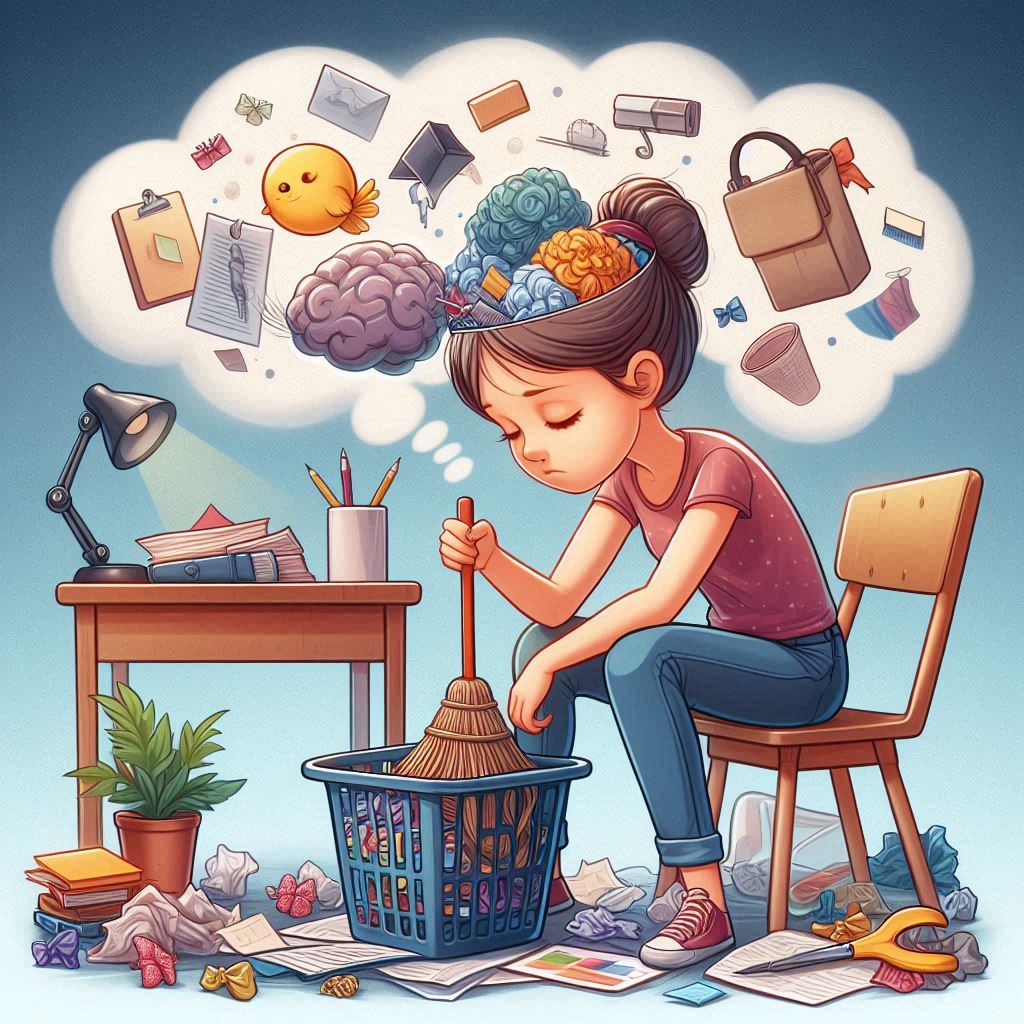
Do we see something similar in the confines of our personal space? How uneasy does it feel to have a pile of unwashed dishes waiting to be tended to in the sink for a prolonged number of days? Or to have one’s belongings scattered all around one’s space, with more and more objects adding to the mess? To constantly not know where to find what one needs, and spend hours digging into a bunch of useless things to find it? To find something we value and want to have close to us regularly, but to end up quickly losing it in the sea of things we would rather be rid of?
All the above situations have a lot in common. We are left feeling uneasy, agitated, and devoid of focus or peace both by being surrounded by a melange of unmanageable, ever-growing clutter, and being in a highly noisy and congested environment. Chaos causes distress. Are there other comparable scenarios that make us feel the same way?
What if we move the environment one step closer – from the noisy street to our immediate living space, now to inside our own bodies and minds? For the purpose of this article, let us stick to the part of our body that we most often occupy consciously – the mind. What happens when the mind is over-occupied, overburdened, and lacking organization?
Defining mental clutter
One may define mental clutter as anything that makes the mind feel disordered, over-full, messy, distracted, and overwhelmed. It comprises a disorganized accumulation of thoughts, ideas, emotions, worries, impulses, memories, and distractions that fill up the mind. Our intrusive thoughts, overthinking, racing ideas, ruminating, excessive worrying, unresolved issues, conflicting priorities, and information overload are all examples of mental clutter.
A simple and most elementary instance of mental clutter, as exemplified by the first paragraph above, is multi-tasking. Our brains can focus only on one thing at a time. When one multi-tasks, one is constantly shifting one’s attention from one thing to the other, and building up a “clutter” of things for our minds to keep track of. In most cases, this leads to stress, overwhelm, and likely to all of the tasks being done less efficiently than if they were to be done one at a time and given full attention. Another related example is the lack of record-keeping. When we try to keep too many things in our memory, this quickly leads to a pile of mental clutter, which in turn makes us feel disorganized, overburdened, and like we keep forgetting things. A simple list or record of things to be done or remembered, arranged by urgency or importance, is a game-changer when it comes to clearing up this clutter. Similarly, journaling and keeping a record of our own emotional states, behaviour, and thoughts, reduces the burden of holding everything inside and remembering what makes us truly feel better and what does not.
Another very talked-about example is the overabundance of information, images, impressions, and opinions that flood us during the consumption of social media. While stepping away from social media can surely in many cases provide some instant relief from the bombardment with too many images and ideas, abstaining from social media does not guarantee peace or freedom from mental clutter.
Another less spoken-about instance of mental clutter is a lack of emotional boundaries. When one has a strew of unlabelled thoughts, emotions, and perceptions floating around one’s conscious and unconscious mind, it can become difficult to separate out which are truly one’s own, and which come from other people. Over time, the enmeshment of cognitive and emotional material between people builds up a pile of clutter that can be excruciating to sort through. As an oversimplistic example, a person who loves to cook, and finds the activity rewarding in terms of both the outcome and the process, may be surrounded by others who feel that cooking is too time-consuming, annoying, and rewardless. When this emotion is expressed over and over by people in this person’s immediate environment, it may spill over and he may start, in a way, to also believe in its truth and dilute or lose his own sentiment. Mental clutter caused by a lack of labels and boundaries between the emotions of others and oneself can lead over time to far more insidious effects, like the mass brainwashing of a population towards a dangerous or violent ideology.
Effects and causes
As most people would acknowledge, mental clutter leads to feelings of overwhelm, confusion, and stress, making it hard to focus on the present task, gain clarity, make decisions, read our own emotions, and even listen to our body’s physical cues. It can eat away at our time and make us feel like we can never truly rest. It takes away from our peace and disconnects us from the present moment and the experiences we value. In the long term, it can lead to mental exhaustion, declined productivity, poor decisions, anxiety, burnout, addiction, and other health issues.
Mental clutter can be caused by a broad spectrum of factors, such as a stressful environment, unnecessary worry and overthinking, excessive multitasking, perfectionism, unresolved and repressed emotional experiences, hidden thought and behaviour patterns, lack of boundaries and segregation, information overload, overuse of digital devices, physical clutter, and a lack of self-esteem. Often, a prominent cause is a lack of effective emotional and cognitive regulation and management. Mental clutter and emotional overwhelm result from the inability to recognize and label one’s own emotions, thoughts, and behaviour patterns, to separate out a hunch or feeling from reality, to organize one’s knowledge (or lack thereof) and intentions, and to structure our lives to be directed towards what we truly value.
While the above paragraph may make the problem sound very unhealthy, there is nothing abnormal or pathological about having mental clutter. Some amount of mental clutter is expected and normal, especially given the fast pace and overabundance of information in the lives we live today. Therefore, perhaps the most common cause of mental clutter is simply life itself, combined with a lack of the skills to manage one’s own cognitive mess.
Managing mental clutter is by no means an instinctive ability. Rather, it is a learned skill that comes with conscious reflection, self-awareness, and constant practice. We spend years going to school and college to learn not only information about the world, but more importantly, to learn how to organize our intellectual thoughts and absorb and assimilate new information quickly. Unfortunately, we are provided no emotional counterpart of this education, and so most of us go about freestyling, learning by error, or simply denying the need for it. However, as with intellectual information, it is far more efficient and effective to structure our efforts in this domain. Among all emotional intelligence skills, perhaps the easiest and most universally worthwhile one to learn is to manage and mitigate the clutter in one’s mind.
In the next part of the article, I will discuss some management strategies I’ve read about when researching this topic, and some others that come from my own experience.