It has been about a year since I finished reading Charles Dicken’s celebrated “Hard Times”, and I am only now coming round to make this long-procrastinated post. Since it has been so long since I wrote about a fiction book, I decided to start with a short detour, as to the point of this exercise, and why I enjoy it.
Hoarding impressions from novels
Every time I read a classic that I like (well, to an extent, I do this for every book that I read), I make sure to stash away my favourite parts, quotes, dialogues, phrases, and messages from the book. This way, I get to keep my most treasured portions of the book with me forever. Even at the times when I don’t remember the characters or plot so well, and when I am too busy to re-read the whole book, I have my own personalized segments saved away preciously to revisit as I please.
Most books, especially fiction, are not mere prose, or mere stories of characters entangled in familiar or peculiar situations—they are far beyond that. We don’t love books for the stories they tell, or for the characters they harbour, or for the lessons they leave us with — we love and cherish them for how they make us feel. For the moments of recognition or alien fascination with the characters and circumstances, for the admiration of the strong traits of some of the characters, for our sympathy with their suffering, for our joy at their happy endings, for the annoyance or disgust at the antagonists or at the cruelty of fate, for the thrill of wanting to know the ending.
In books written centuries ago, in lands one has never visited, by an unfamiliar figure with whom one shares not a shred of similarity of reality, perhaps not even a common language, one can find a feeling of intimate recognition, familiarity, and connection, relating more to a fictitious character in a story than to one’s own neighbours. In a book well-written, one relates, surely, in varying degrees, to the psyche and actions of each character, and recognizes a part of their own lives, however different in concrete nature, in the circumstances in the novel. Indeed, emotions are the most universal of all languages.
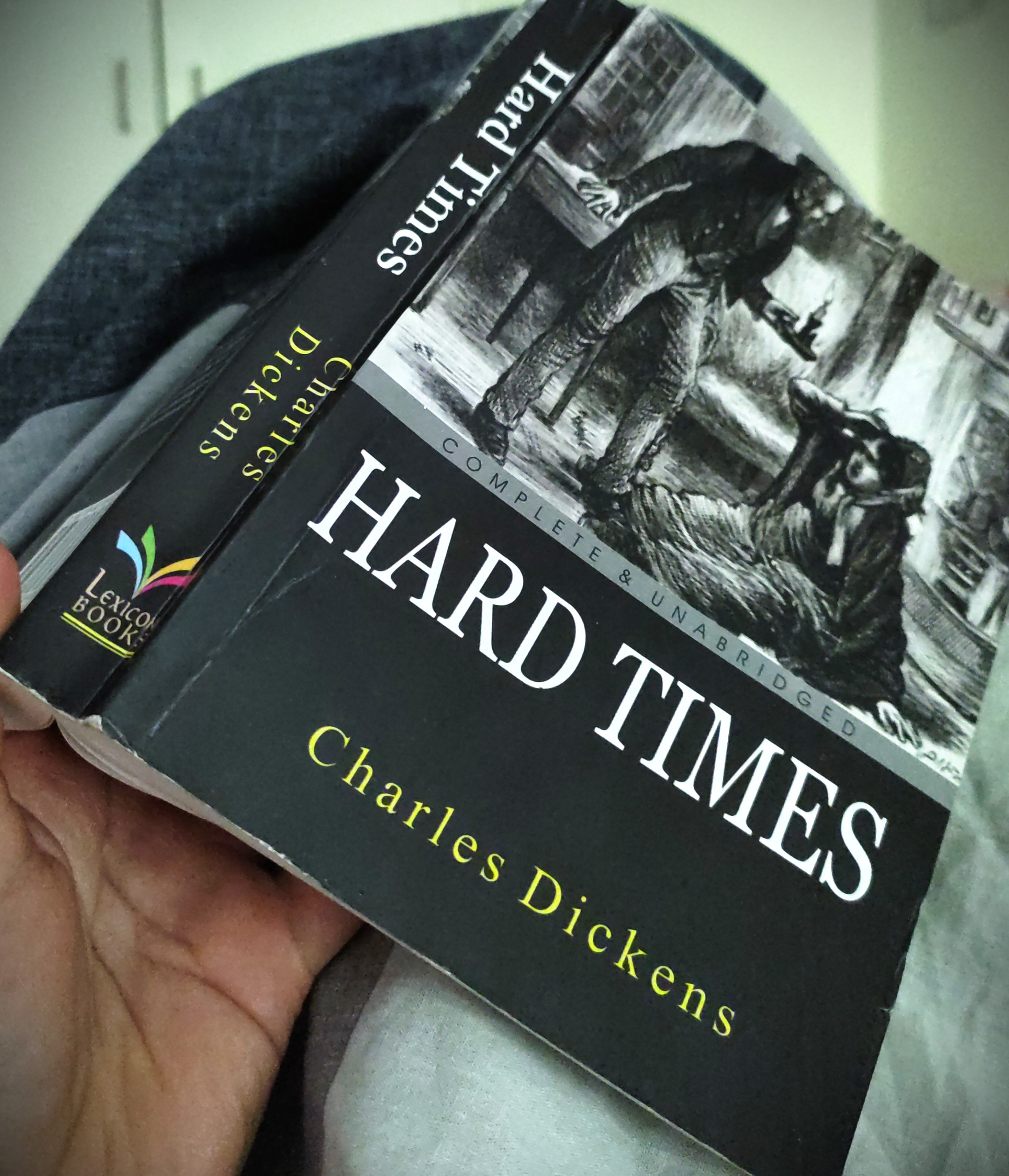
‘Hard Times’ is a novel by Charles Dickens, first published in 1854. It is set in the fictional industrial town of Coketown in Great Britain and explores the societal and economic issues of Victorian England, and particularly the harsh conditions faced by the working class during the Industrial Revolution. It does this through the stories of several characters, but the main protagonists, from my viewpoint, are Louisa Gradgrind and Stephen Blackpool.
Lousia and Stephen come from opposing social and economic backgrounds. Louisa is the daughter of Thomas Gradgrind, a wealthy and influential businessman, and grows up with the privilege of material wealth and comfort. However, her father is a strict and cold rationalist who sees nothing of significance beyond facts and thereby trivializes emotional experiences. Louisa therefore grows up in an environment of rigid rules, emotional neglect, and stifled personal development. Nevertheless, Louisa embodies both personal integrity and empathy for others. Stephen Blackpool is a working-class honest man employed at a daily wage at one of the factories in Coketown. He lives in difficult circumstances, lacking financial security and social status, and struggling to make ends meet despite harsh conditions of the factory. Due to his wife’s alcoholism and insanity, Stephen also lacks meaningful human relationships or emotional connection. Despite his poor fate, Stephen is honest, hardworking, and morally upright.
The other key character is that of Louisa’s father, Thomas Gradgrind, who is an influential member of the school board and a successful businessman. Mr. Gradgrind is characterized by his strictness, rigidity, fervent belief in the importance of facts, reason, and practicality, and his trivialization of emotions and subjective experiences like imagination. He raises his children, Louisa and Tom, according to these principles. He dedicates his parenthood to molding his children into rational, productive members of society. While the complex Mr. Gradgrind is rigid, cold, and unfeeling throughout, he lacks the sentiment of evil and selfishness in Mr. Bounderby, and in fact, undergoes a severe transformation towards the end. His character serves as a symbol of the dehumanizing effects of industrialization and utilitarianism during the Victorian era. Dickens uses him to critique the cold, mechanistic approach to life advocated by some segments of society, and to demonstrate the dire consequences of prioritizing materialism and rationality over human connection and compassion. The following stanza from the book is the perfectly concise summary of the character of Mr. Gradgrind
In gauging fathomless deeps with his little mean excise-rod, and in staggering over the universe with his rusty stiff-legged compasses, he had meant to do great things. Within the limits of his short tether he had tumbled about, annihilating the flowers of existence with greater singleness of purpose than many of the blatant personages whose company he kept.
The stark contrast between Louisa and Stephen’s backgrounds expresses itself throughout the novel, highlighting the societal divides of Victorian England. Louisa represents the privileged upper class, insulated from the hardships faced by the working class. The self-absorbed vanity and selfish greed of the upper class is brought out by Mr. Bounderby, the husband of Louisa and best friend of her father. Mr. Bounderby, a wealthy and influential businessman, is vain, boastful, dishonest, and constantly hungry for approval and praise. He is condescending and cruel to everyone around him, and appears to show no real emotions of concern or sympathy. He is an embodiment of the spirit of cold, calculating, self-centered capitalistic upper class of the time, dismissive of all subjective experience and obsessed with rationalizing and optimizing. On the other hand, Stephen embodies the struggles and injustices endured by those at the bottom of the social hierarchy. The two other important poor characters in the book, Rachael and Jupe, too, are depicted as warm, empathetic, calm, and collected, showing concern for others even while having barely any material possessions or social status of their own.
Despite the differences between the protagonists Stephen and Louisa, both characters ultimately grapple with the limitations and consequences of the society in which they live. The story is centered around Louisa’s emotional repression and restricted freedom, and Stephen’s economic plight and social isolation. In this process, the novel explores the themes of class, morality, and human emotions.
Favourite Quotes
The Redemption of Mr. Gradgrind
The confrontation between Louisa and Mr. Gradgrind, and the affect of this exchange on him, are among the most powerful scenes in the whole book.
In expressing her frustrations to her father, the dialogue by Lousia is a graceful yet forceful wording of the perils of emotional repression, the neglect of joyful experiences, and restricted freedom.
‘How could you give me life, and take from me all the inappreciable things that raise it from the state of conscious death? Where are the graces of my soul? Where are the sentiments of my heart? What have you done, O father, what have you done, with the garden that should have bloomed once, in this great wilderness here!’
This powerful dialogue by Louisa strikes a sharp chord in the rigid Mr. Gradgrind, making him realize his faults. Indeed, the conviction and deep pain with which it is delivered, the absolute certainty in a person who is so hurt that she knows without a doubt where and how much she has been wronged, play a key role in driving the message to the walled heart of Mr. Gradgrind.
If she had asserted any influence over him beyond her plain faith in the truth and right of what she said; if she had concealed the least doubt or irresolution, or had harboured for the best purpose any reserve or pretence; if she had shown, or felt, the lightest trace of any sensitiveness to his ridicule or his astonishment, or any remonstrance he might offer; he would have carried it against her at this point. But he could as easily have changed a clear sky by looking at it in surprise, as affect her.
The effect that comes about on Mr. Gradgrind shows that he was no monster, but rather a well-intentioned but heavily misguided person.
‘Some persons hold,’ he pursued, still hesitating, ‘that there is a wisdom of the Head, and that there is a wisdom of the Heart. I have not supposed so; but, as I have said, I mistrust myself now. I have supposed the head to be all-sufficient. It may not be all-sufficient; how can I venture this morning to say it is! If that other kind of wisdom should be what I have neglected, and should be the instinct that is wanted, Louisa—’
“He was touched in the cavity where his heart should have been, in that nest of addled eggs, where the birds of heaven would have lived if they had not been whistled away, by the fervour of this reproach.”
Here was Mr. Gradgrind on the same day, and in the same hour, sitting thoughtful in his own room. How much of futurity did he see? Did he see himself, a white-haired decrepit man, bending his hitherto inflexible theories to appointed circumstances; making his facts and figures subservient to Faith, Hope, and Charity; and no longer trying to grind that Heavenly trio in his dusty little mills? Did he catch sight of himself, therefore much despised by his late political associates? Did he see them, in the era of its being quite settled that the national dustmen have only to do with one another, and owe no duty to an abstraction called a People, ‘taunting the honourable gentleman’ with this and with that and with what not, five nights a-week, until the small hours of the morning? Probably he had that much foreknowledge, knowing his men.
Stephen Blackpool: suffering and death
Perhaps the most moving of all the stanzas in the book is the plight of Stephen Blackpool, when he loses his job and is also boycotted socially by his co-workers. While Stephen had lived in adversity throughout his life, and in fact, did not have close ties with anyone for long, his unmatched suffering on being completely isolated socially, being deliberately ignored and rejected by everyone around, is described beautifully by Dickens:
Thus easily did Stephen Blackpool fall into the loneliest of lives, the life of solitude among a familiar crowd. The stranger in the land who looks into ten thousand faces for some answering look and never finds it, is in cheering society as compared with him who passes ten averted faces daily, that were once the countenances of friends. Such experience was to be Stephen’s now, in every waking moment of his life; at his work, on his way to it and from it, at his door, at his window, everywhere. By general consent, they even avoided that side of the street on which he habitually walked; and left it, of all the working men, to him only.
He had been for many years, a quiet silent man, associating but little with other men, and used to companionship with his own thoughts. He had never known before the strength of the want in his heart for the frequent recognition of a nod, a look, a word; or the immense amount of relief that had been poured into it by drops through such small means. It was even harder than he could have believed possible, to separate in his own conscience his abandonment by all his fellows from a baseless sense of shame and disgrace.
The scenes of Stephen’s fateful death are not only emotionally moving and sad, but also momentous, since they etch out his good character, which shines out even in his times of utter suffering. Even in his death, Dickens highlights the class divide, stating that Stephen had gone to the “God of the poor”.
‘I ha’ been, but not now. I ha’ been—dreadful, and dree, and long, my dear—but ’tis ower now. Ah, Rachael, aw a muddle! Fro’ first to last, a muddle!’
The spectre of his old look seemed to pass as he said the word.
‘I ha’ fell into th’ pit, my dear, as have cost wi’in the knowledge o’ old fok now livin, hundreds and hundreds o’ men’s lives—fathers, sons, brothers, dear to thousands an’ thousands, an’ keeping ’em fro’ want and hunger. I ha’ fell into a pit that ha’ been wi’ th’ Firedamp crueller than battle. I ha’ read on ‘t in the public petition, as onny one may read, fro’ the men that works in pits, in which they ha’ pray’n and pray’n the lawmakers for Christ’s sake not to let their work be murder to ’em, but to spare ’em for th’ wives and children that they loves as well as gentlefok loves theirs. When it were in work, it killed wi’out need; when ’tis let alone, it kills wi’out need. See how we die an’ no need, one way an’ another—in a muddle—every day!’
He faintly said it, without any anger against any one. Merely as the truth. (emphasis my own)
They carried him very gently along the fields, and down the lanes, and over the wide landscape; Rachael always holding the hand in hers. Very few whispers broke the mournful silence. It was soon a funeral procession. The star had shown him where to find the God of the poor; and through humility, and sorrow, and forgiveness, he had gone to his Redeemer’s rest.
Frivolous characters, frivolous endings
While Stephen dies an honourable death, in stark contrast to how he was treated his whole life, the two characters embodying vanity and selfishness, Mr. Bounderby and Tom, both meet an inglorious end, with the latter ending up having to flee the country, and the former ending up alone and disgraced, exposed for his lies, eventually dying of a fit on the street.
A lonely brother, many thousands of miles away, writing, on paper blotted with tears, that her words had too soon come true, and that all the treasures in the world would be cheaply bartered for a sight of her dear face? At length this brother coming nearer home, with hope of seeing her, and being delayed by illness; and then a letter, in a strange hand, saying ‘he died in hospital, of fever, such a day, and died in penitence and love of you: his last word being your name’? Did Louisa see these things? Such things were to be.
Did he see any faint reflection of his own image making a vain-glorious will, whereby five-and-twenty Humbugs, past five-and-fifty years of age, each taking upon himself the name, Josiah Bounderby of Coketown, should for ever dine in Bounderby Hall, for ever lodge in Bounderby buildings, for ever attend a Bounderby chapel, for ever go to sleep under a Bounderby chaplain, for ever be supported out of a Bounderby estate, and for ever nauseate all healthy stomachs, with a vast amount of Bounderby balderdash and bluster? Had he any prescience of the day, five years to come, when Josiah Bounderby of Coketown was to die of a fit in the Coketown street, and this same precious will was to begin its long career of quibble, plunder, false pretences, vile example, little service and much law? Probably not. Yet the portrait was to see it all out.
The redemption of Mr. Gradgrind
Author’s reflections: time, the human condition, closing
Some stanzas in the book bring out the deep contemplations and ideas of the author, relating not only to the story, but to all of life and human existence. The following line, perhaps more relevant now than ever, highlights the long way humanity has come in building things, and its pride in its own creations.
Never fear, good people of an anxious turn of mind, that Art will consign Nature to oblivion. Set anywhere, side by side, the work of God and the work of man; and the former, even though it be a troop of Hands of very small account, will gain in dignity from the comparison.
The following stanza describes in poetic terms, the silent, relentless work of time, metaphorically as a spinner of wool.
It seemed as if, first in her own fire within the house, and then in the fiery haze without, she tried to discover what kind of wool Old Time, that greatest and longest-established Spinner of all, would weave from the threads he had already spun into a woman. But his factory is a secret place, his work is noiseless, and his Hands are mutes.
By far, the most eloquent and consequential message from the author lies in the following paragraph about morality, which, I believe, is as relevant as ever today. Contrary to what we would typically imagine, prevalent immoral actions that hurt others and oneself do not go about dressed as the devil, proclaiming their evilness and intentions. So much of the suffering in the world is caused by bad actions disguised by good or seemingly good intentions, served up as collected, seemingly rational and calculated declarations.
And yet he had not, even now, any earnest wickedness of purpose in him. Publicly and privately, it were much better for the age in which he lived, that he and the legion of whom he was one were designedly bad, than indifferent and purposeless. It is the drifting icebergs setting with any current anywhere, that wreck the ships.
When the Devil goeth about like a roaring lion, he goeth about in a shape by which few but savages and hunters are attracted. But, when he is trimmed, smoothed, and varnished, according to the mode; when he is aweary of vice, and aweary of virtue, used up as to brimstone, and used up as to bliss; then, whether he take to the serving out of red tape, or to the kindling of red fire, he is the very Devil.
The closing of the book, and of this post, is with this final stanza from Charles Dickens.
Dear reader! It rests with you and me, whether, in our two fields of action, similar things shall be or not. Let them be! We shall sit with lighter bosoms on the hearth, to see the ashes of our fires turn gray and cold.